Oil Grabs the Wheel
The sector leadership I have been tracking for a month just changed hands. And the same thing that crowned the new leader is quietly taxing everyone else.

For about four weeks now I have been telling you the same story off my board. Financials and healthcare are leading. Technology is stuck near the bottom. Quality is winning. It was true, and I kept saying it because it kept being true.
This week it stopped being true.
The leaders got tired, the money went looking for a new home, and it found one in the last place a growth-obsessed market usually looks: the stuff you can actually touch. Oil. Metals. Materials. The boring, heavy, real-world economy. And once you see why it happened, you see that the whole tape this week was being run by a single thing, and that thing was the price of a barrel of oil.
The old leaders ran out of gas
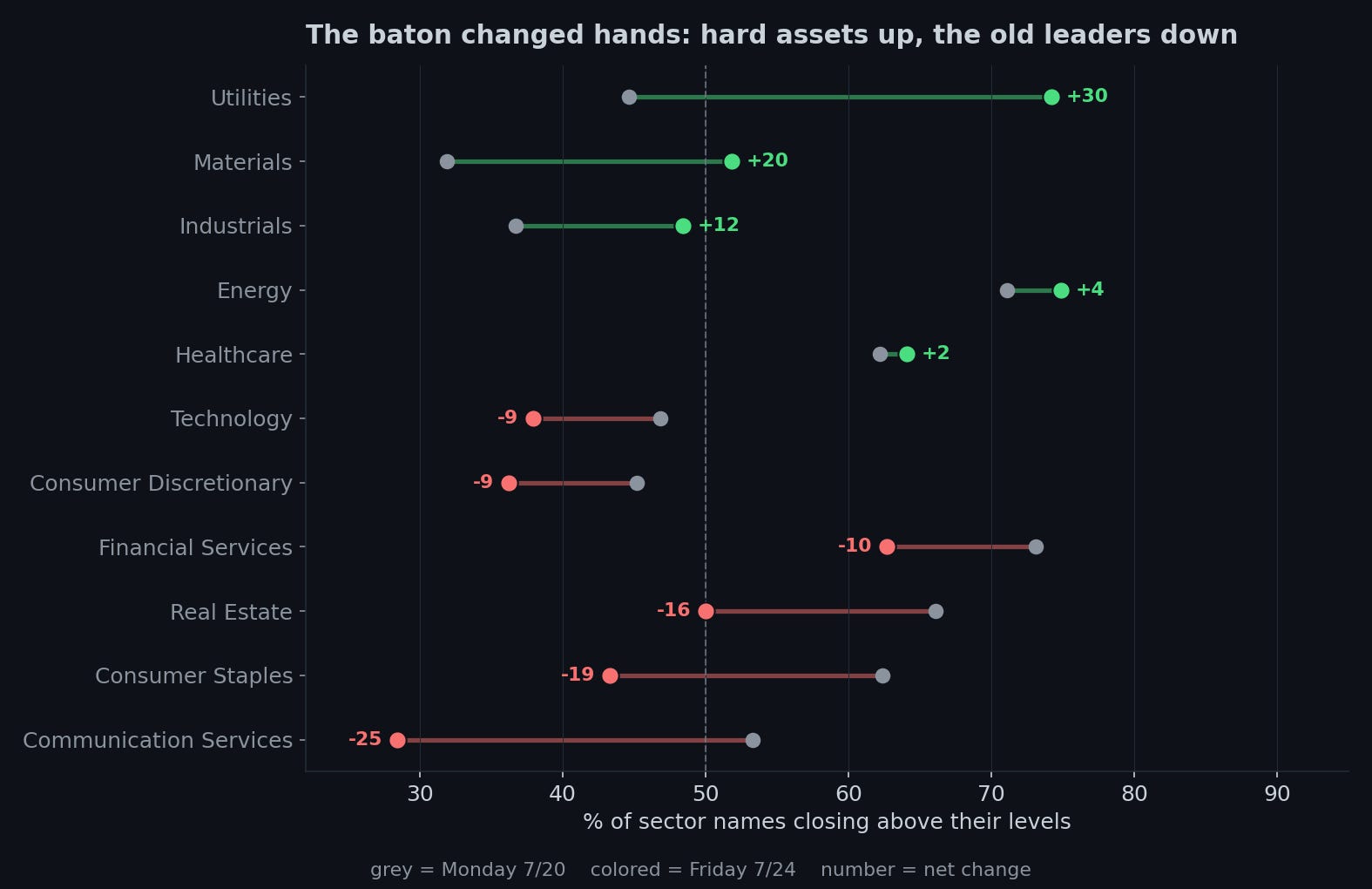
Start with what actually moved.
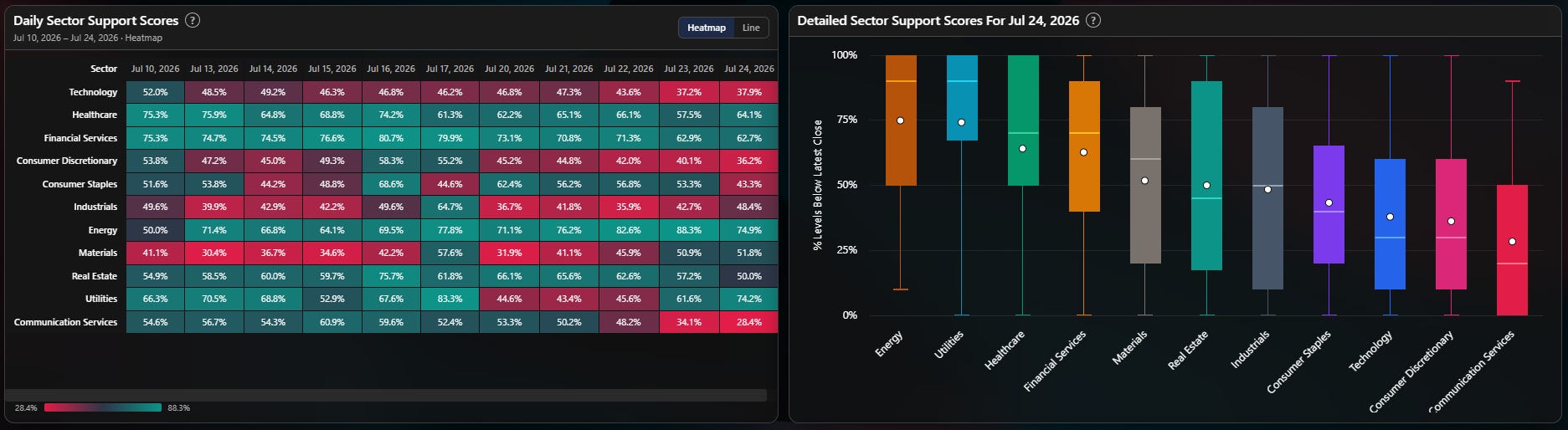
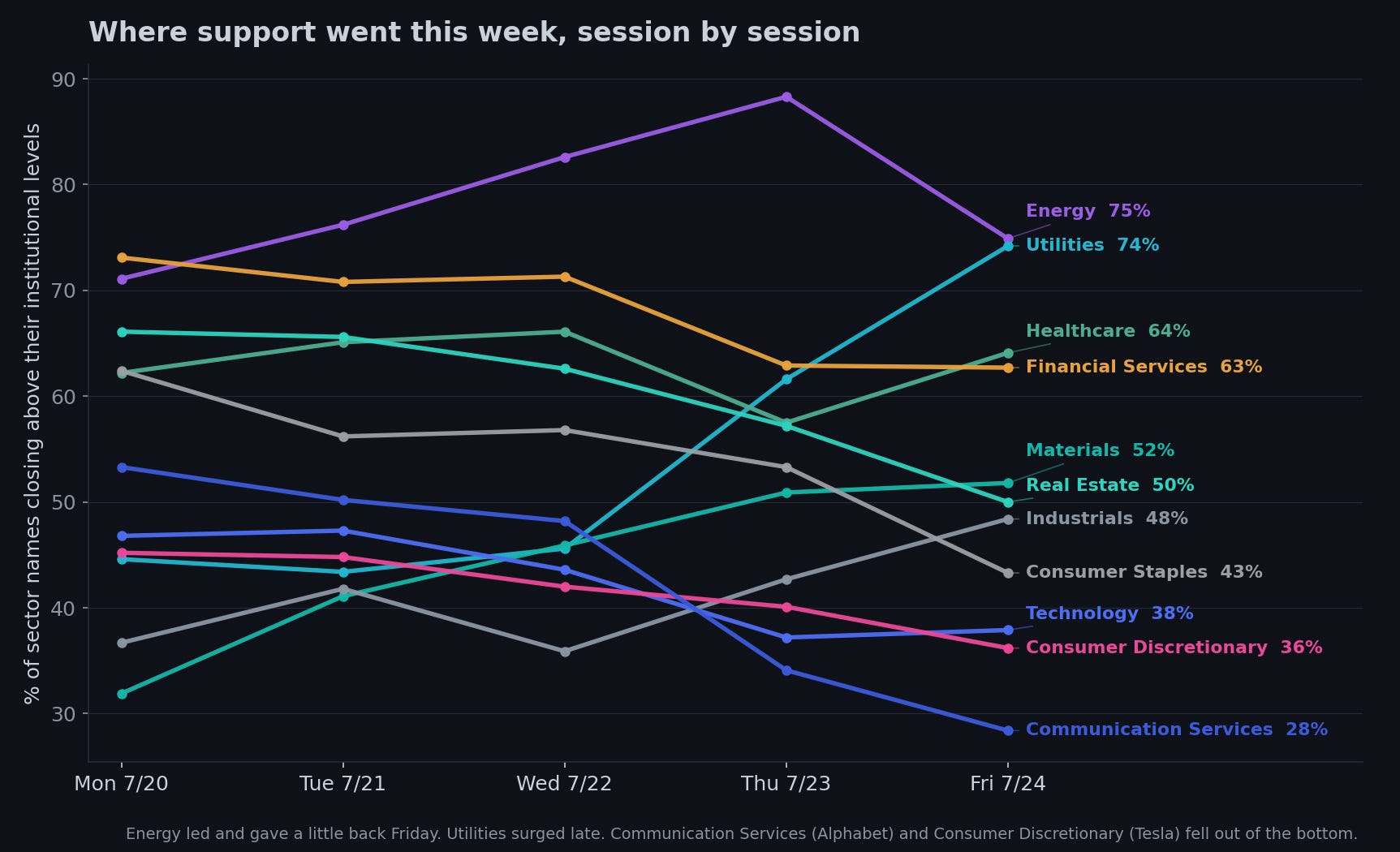
Financial Services, my number one sector for a month, dropped about 10 points of support on the week. Real Estate dropped 16. Consumer Staples dropped 19. These were three of the sturdy, sensible places money had been hiding, and all three sprang a leak at the same time.
You can see it even more clearly on my rotation graph, which tracks where each sector sits on two axes at once: how strong it is, and whether that strength is building or fading. Financial Services, Healthcare, and Real Estate have all drifted into the same corner of that chart. It is the corner nobody wants, the one where a sector is still ranked high but its momentum has turned and started pointing down. That is what a leader looks like right before it stops being one. Not a crash. Just a slow loss of altitude that shows up in the momentum before it shows up in the price.
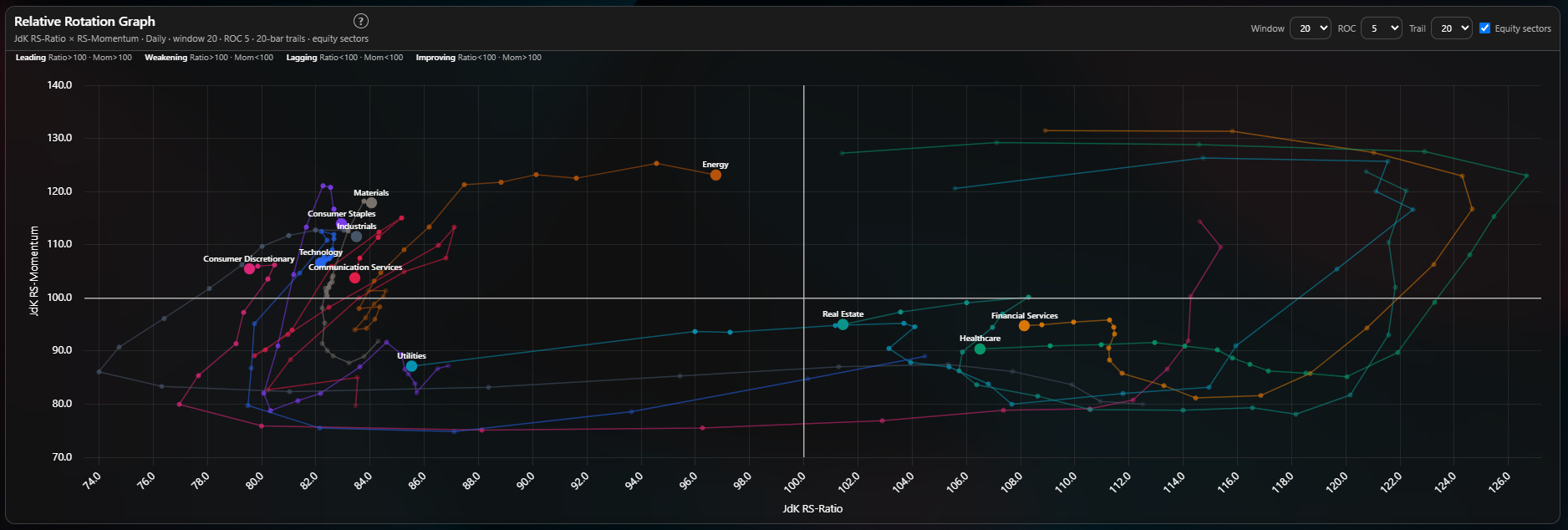
So the quality trade did not blow up this week. It just got tired. There is a difference, and the difference matters, because tired leaders can rest and come back, or they can roll over. Right now I genuinely cannot tell you which, and I will come back to how you will know.
Where the money went instead
While all that was leaking, one sector sat at the top of my board and stayed there: Energy. It closed the week as the single strongest sector I track, and on Thursday nearly nine out of ten energy names were trading above their institutional levels. Right behind it, Materials climbed almost 20 points on the week, and on my momentum, relative-strength, and risk-adjusted-return screens, the two best names on the entire board were Energy and Commodities.
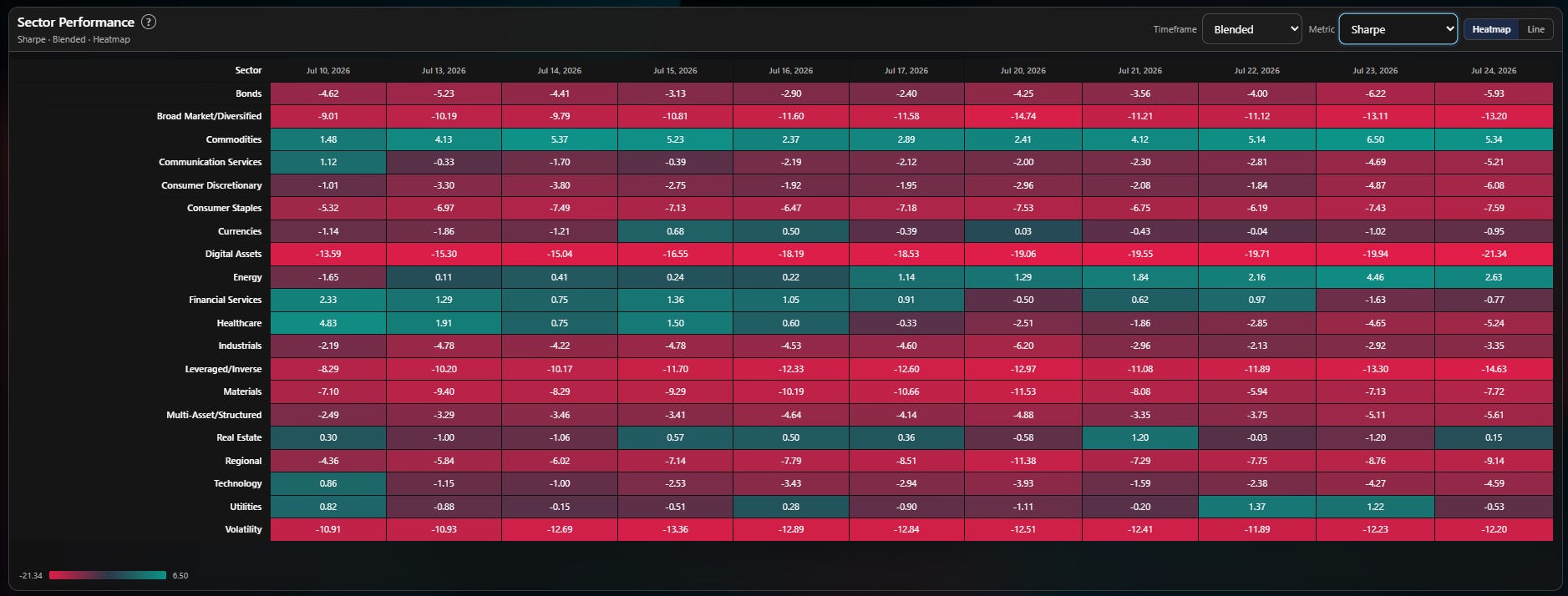
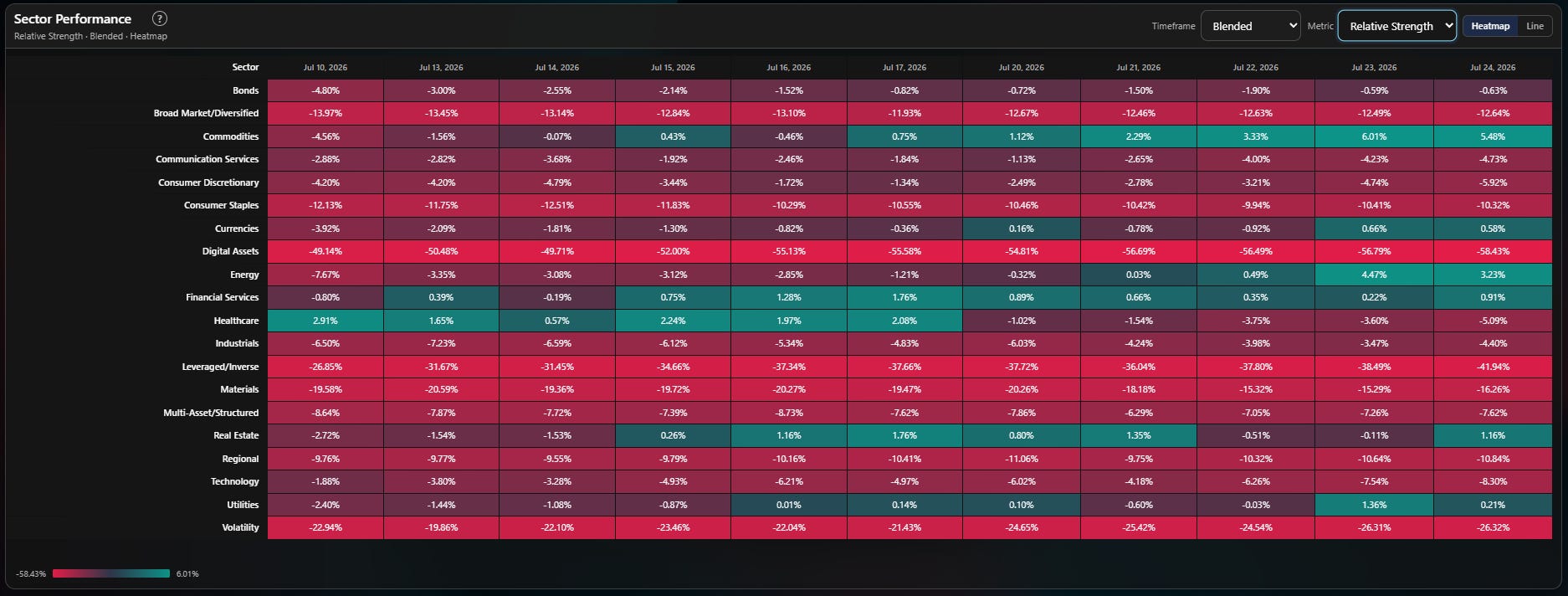
Put plainly: the money that left banks and real estate did not leave the market. It walked across the street and bought oil, metals, and the companies that dig things up. Hard assets. Real stuff.
There is a reason that rotation happens together like this, and it is not a coincidence. It has a cause, and the cause is the whole story of the week.
One barrel, two jobs
Here is the thing I want you to walk away with.
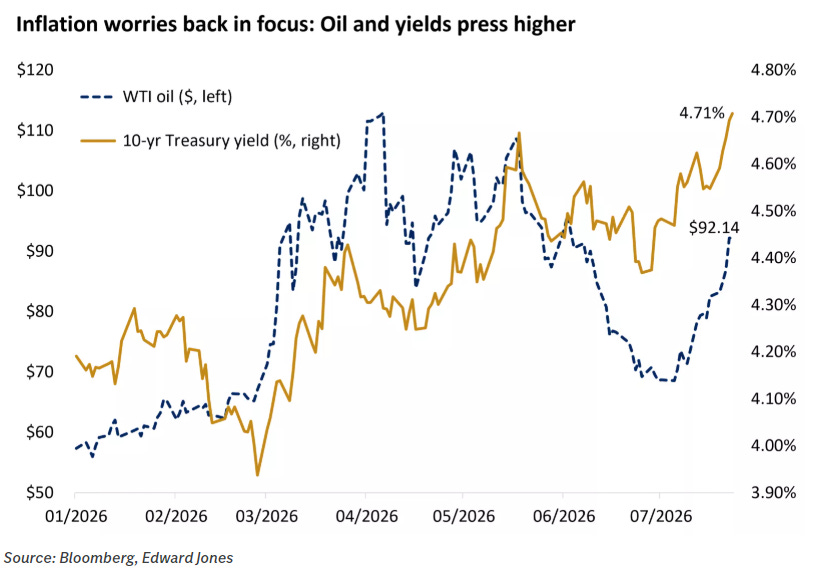
The conflict between the US and Iran kept escalating this week, and oil kept climbing right along with it. That is good news for exactly one group of stocks, the ones that sell oil, which is why Energy is sitting on top of my board. Simple enough. Rising oil, rising oil stocks.
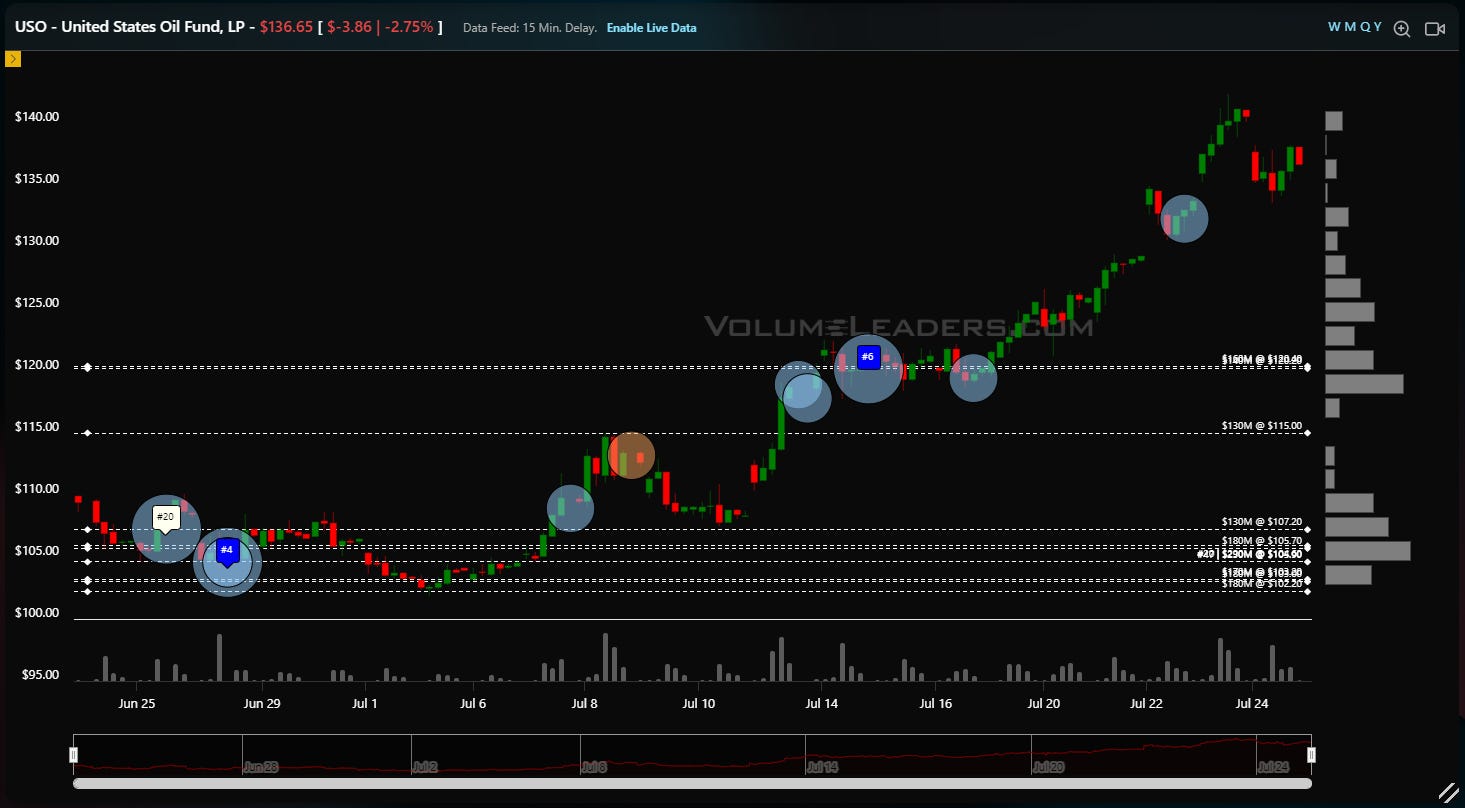
But rising oil does a second job at the same time, and this is the part people forget. Expensive oil feeds straight into inflation, and the fear of inflation pushes interest rates back up. Sure enough, borrowing costs climbed hard this week. The 10-year Treasury yield broke above 4.70 percent for the first time since January 2025, and the 30-year is now at its highest since 2007. And high rates are poison for a very specific kind of stock: anything whose value depends on profits way out in the future, and anything that has to borrow a lot to operate.
I am not the only one making this connection. Oil pushing back toward $100 is reigniting inflation concerns and chatter is back over whether the Fed may need to respond. The bond market now prices a one-in-three chance of a rate hike as soon as this month, and a hike by September is close to fully priced in. A month ago the market was arguing about rate cuts. Now it is bracing for the opposite, and oil is the reason why.
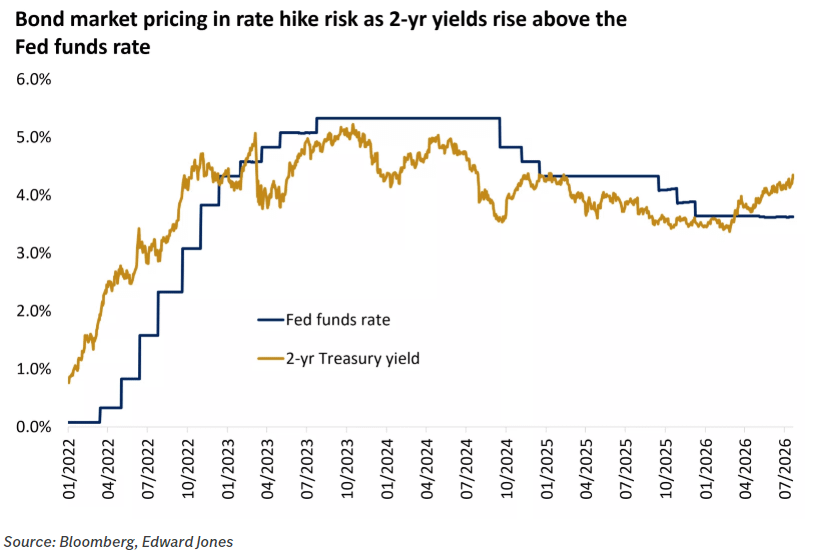
So the same barrel of oil is doing two jobs at once. With one hand it is lifting the energy sector. With the other hand it is quietly reaching into the rest of the market and raising everyone’s cost of money. That is why this does not feel like a normal rotation where one group wins and another loses for its own reasons. It is one force, oil, splitting the market into the stuff that likes it and the stuff that cannot stand it.
Once you hold that idea, the confusing parts of the week stop being confusing.
Thursday, where you could watch it happen
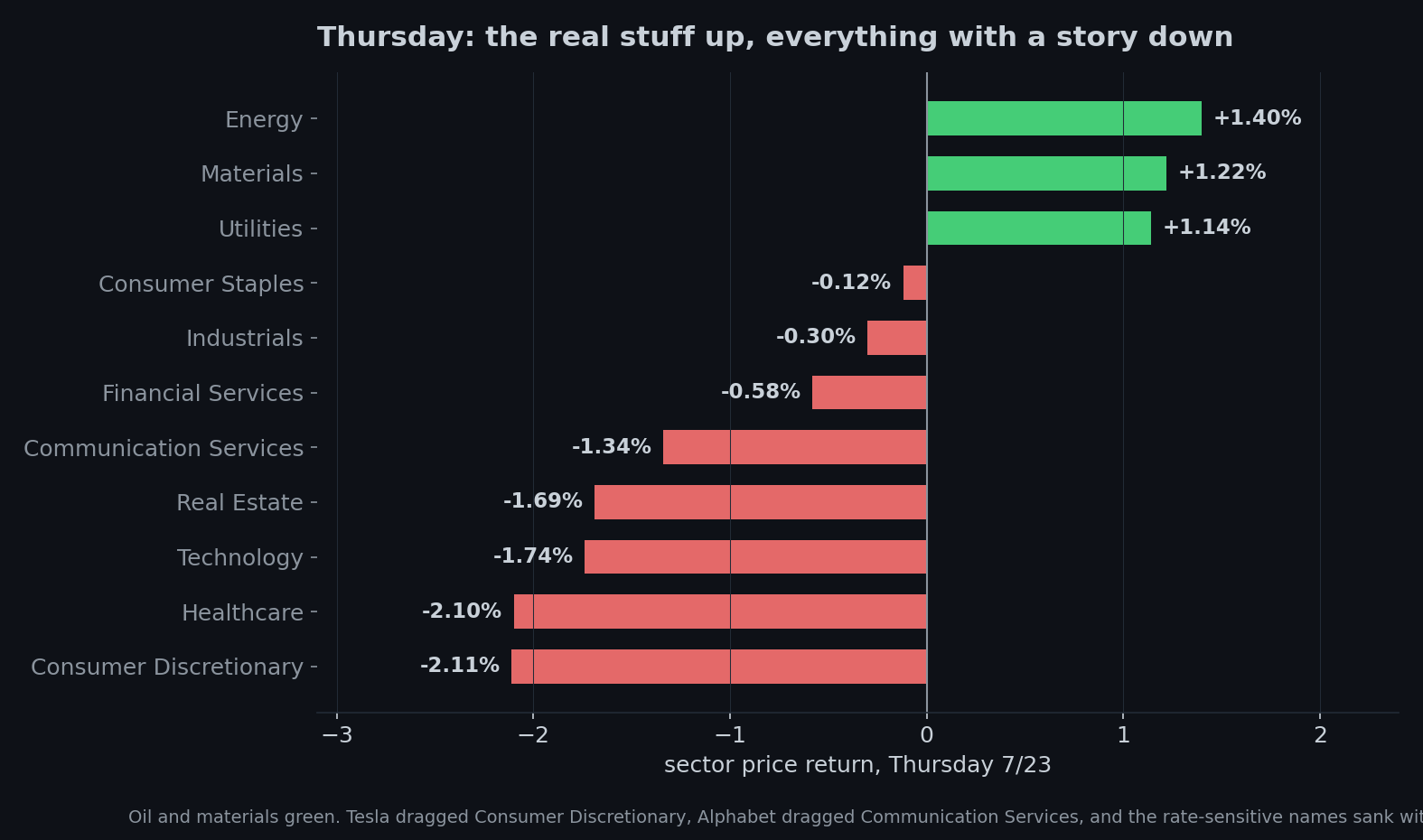
Thursday was the cleanest single day of the whole thing. Look at how the sectors split.
Green on the day: Energy, Materials, Utilities. Up. The real-stuff sectors, plus the one boring corner people run to when they get nervous.
Red on the day, and not a little red: Consumer Discretionary, Healthcare, Technology, Real Estate, Communication Services. Down, most of them more than one and a half percent.
Two of those red sectors have names on them. Tesla reported earnings and the market hated them, and Tesla is big enough to drag all of Consumer Discretionary down with it. Alphabet, the company that owns Google, is the more interesting case. Its results were actually good, cloud revenue up 82 percent, plenty of AI demand. The market sold it anyway, because Alphabet also said it would spend even more than expected to keep up, raising its capital budget for the year to roughly 195 to 205 billion dollars. Investors have started flinching at how much these companies are spending to stay in the AI race, and good numbers were not enough to cover it. Alphabet is big enough to take all of Communication Services down with it, and it did. On my board, Communication Services support fell 25 points on the week and finished dead last, almost entirely one enormous stock getting punished for spending too much.
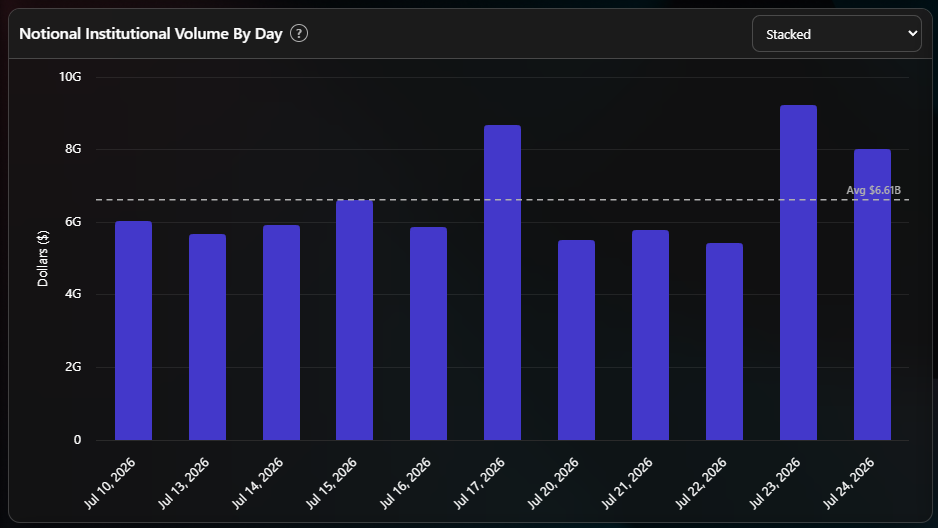
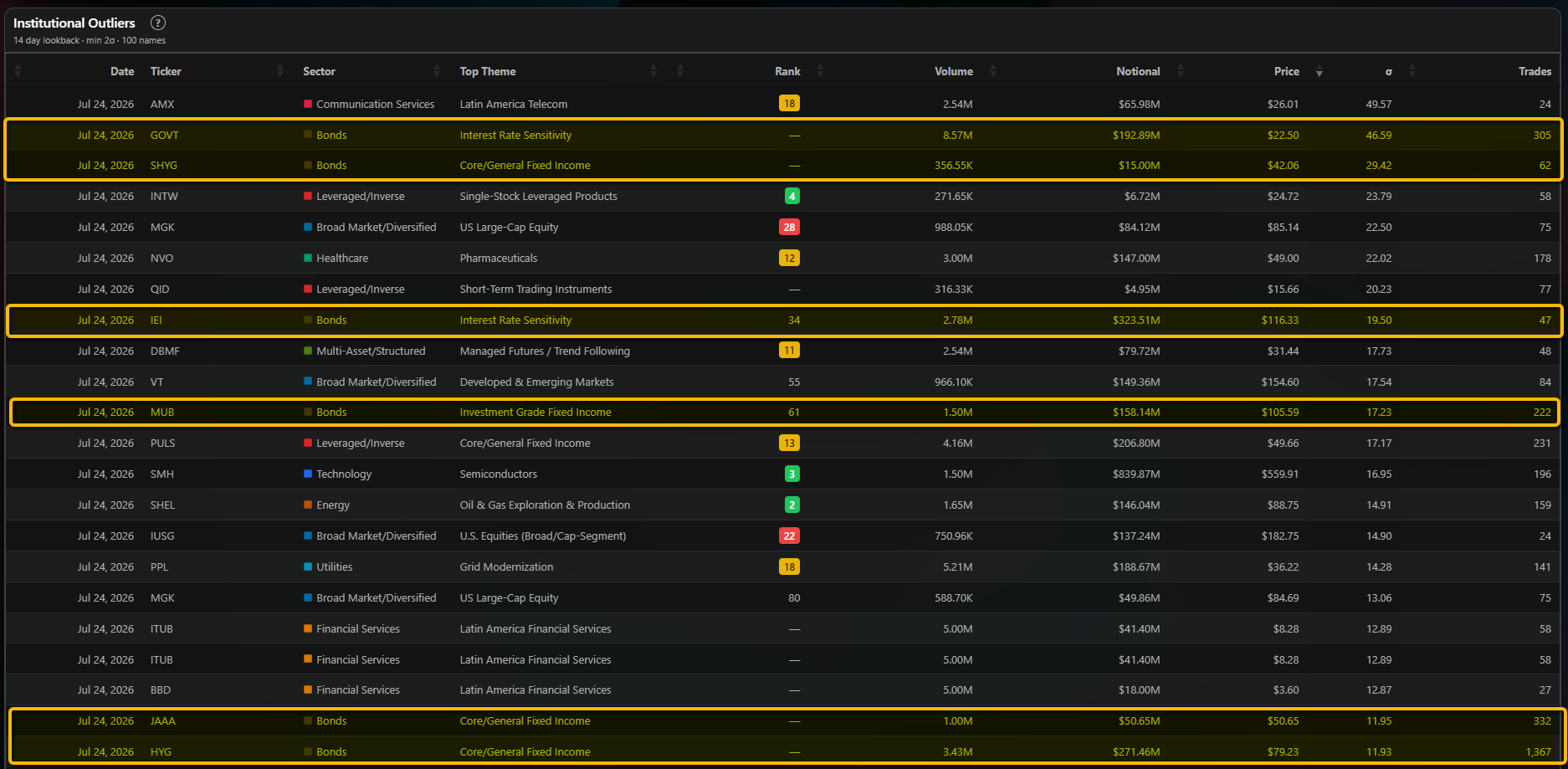
So the growth names got hit two ways at once this week. Rising rates made all of them worth a little less on paper, and then a couple of the biggest ones went and posted numbers nobody liked. When the tax and the bad news land in the same week, you get a Thursday like this. Bond-related names have been trading heavier-than-average and making regular appearances on our Institutional Outlier chart that bubbles-up trades of unusual size relative to a ticker’s history.
The one strange guest at the party
There is one piece that does not fit the tidy hard-assets-are-winning story, and I am not going to hide it, because it is interesting.
Utilities. My most boring sector, the one full of power companies that basically function as bonds with a logo. Its support did not just rise this week, it exploded, up almost 30 points, more than any other sector by a mile. And Utilities are rate-sensitive, so in a week where rates went up, they should have struggled, not soared.
Here is how I read it, flagged plainly as a read, not fact: When money is fleeing the growth trade and it does not want to plant its whole self in oil, it wants somewhere calm to stand. Utilities are the calmest, most defensive corner of the stock market. So the utility surge is not really a bet on utilities. It is a bet against everything else, money looking for a fire exit that still technically counts as owning stocks. When you see hard assets ripping and utilities ripping at the same time, that is not one trade. That is two different flavors of the same instinct, which is get me out of growth.
So is this healthy or not
If you’re M.O. is “get long and stay calm”, the calm reading is that this is just rotation, and rotation is how a bull market stays alive. Money is not leaving stocks, it is moving around inside them, from the expensive crowded corner to the cheap real-economy corner. Earnings season is underway, the banks that already reported said the consumer looks fine, and a market that keeps finding new leadership is a market that is still working. Nothing here is broken. It is just reshuffling.
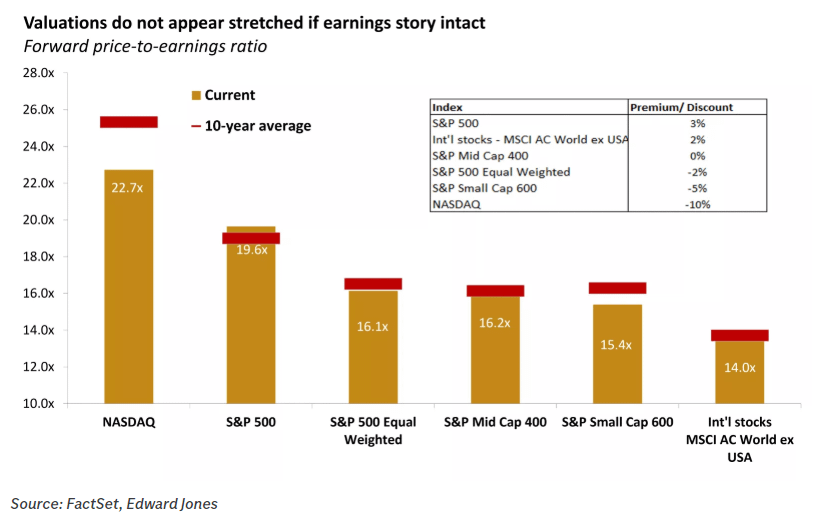
If this massive rotation that has decimated everyone’s favorite names is giving you pause, I’d say the nervous reading is that the summer rally, by the seasonal calendar, ended about a week ago, right on schedule. The S&P this week broke down out of the range it had been sitting in, which technically points lower from here. The momentum signals rolled over. And the ugliest corner of the whole market was the speculative one, with crypto and the leveraged bet-tripling products getting absolutely taken apart, which is exactly what starts to happen when borrowed money gets nervous and heads for the door. When the riskiest stuff breaks first, sometimes it is just the riskiest stuff, and sometimes it is the canary.
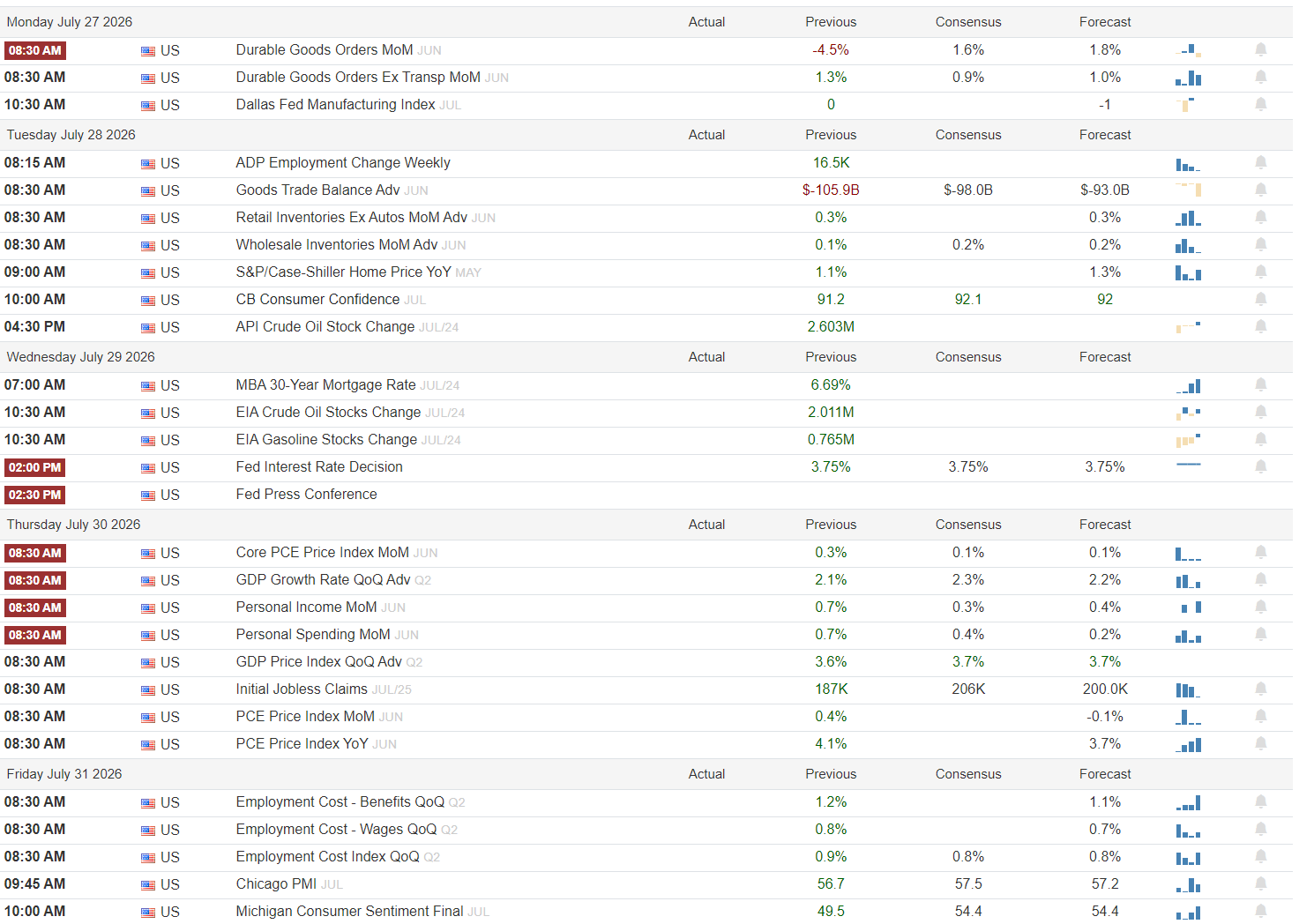
Hanging over all of it is the Fed, which meets this coming Wednesday, July 29. Nobody serious expects a hike at that meeting, but for the first time in a while people are not completely sure, and the fact that the question is even being asked is the point. If oil keeps climbing and the Fed starts sounding worried about it, the higher-for-longer story stops being a forecast and becomes the weather, and every stock that hates high rates keeps paying that tax week after week.
It’s anyone’s guess as to how this resolves. But I can tell you the exact thing to watch that will resolve it, and it is cheap and specific.
Watch whether the money leaving growth keeps finding a home. As long as it does, as long as Energy and Materials and Utilities stay bid while Technology bleeds, this is rotation, and rotation is survivable. You stay invested and diversified, not in a single crowded corner. But if the hard assets start rolling over too, if Energy gives back its lead and nothing else catches the money, then it was never really a rotation. It was the first group heading for the exit, and the rest were just a touch slower. Energy actually gave a little back on Friday, so this is not an idle worry. It is the single thing I will be watching Monday and in the following sessions.
What to do with this, depending on your clock
If you trade in days and weeks, respect what the tape is actually telling you instead of what the headline index says. The leadership is in real assets right now, energy and materials, and it is there for a concrete reason that is still in force, namely oil and the conflict driving it. But that same force broke the range this week and the seasonal wind is no longer at your back, so this is a moment to trade what is working and keep your stops honest, not to plant a flag.
If you invest in years, this week is a small, useful reminder that the thing that helps one part of your portfolio can quietly hurt another, and that the link is often something as old and dumb as the price of oil. A portfolio that owns some real-asset exposure alongside the growth names is not being clever, it is just being built for a world where oil can spike. You did not need to predict this week. You just needed to not be standing entirely on one side of it.
The oldest line I have still holds. The headline said stocks had a rough week. What the money actually did was fire its old leaders, hire oil and metals in their place, and quietly send everyone’s cost of borrowing higher on the way. Same week, three different stories, and only one of them made the front page.
Have a good week out there. Watch what oil does, because right now the rest of the market is just doing whatever oil tells it to.

Thank you for being part of this community and for investing your time in this week’s edition. The quality of this readership — thoughtful, disciplined, engaged — is what makes this work meaningful. I’m grateful to build alongside you. Here’s to a week of clarity, conviction, and well-executed opportunities.
— VolumeLeaders